The Round Sequence
In this chapter10
In this section we will introduce the sequence of Phases that make up a Round and set up the flow and rhythm of the game.
The Phases of Battle
Phases bring order to the chaos of battle, allowing players a framework to direct their Warbands and control their Warriors in the immersive and fierce skirmish combat of Conquest: First Blood.
Games of First Blood are played using Scenarios, dynamically crafted missions that define the objective, set the context, and determine what victory looks like for both players. These Scenarios are available through the Rules & FAQ section of our website.
Battles of First Blood consist of 6 Rounds that are divided into Phases that Players each take part in. Below is a summary of the Phases of a Round and what they consist of.
i. Supremacy Phase
Roll-off to see who will act first this Round!
Both Players Roll a single Die. The Player that Rolls lower is the Supremacy Player and will Act first this Round. If the result is a draw, the Player that has less Victory Points chooses who will be the Supremacy Player. If tied, Re-Roll until a winner is decided!
ii. Command Phase
Perform Command Abilities with your Characters!
The Supremacy Player will perform a single Command Ability with each Character in their Warband, then the other Player does the same. A Command Ability lasts until the end of the Round.
iii. Action Phase
Activate your Warriors and perform Actions.
The Action Phase is the most pivotal Phase in the Round. Players will take turns choosing a single Command Card that has not Activated this Round, flipping over, and perform Actions with its Warriors. The Supremacy Player chooses a single Command Card and Activates all Warriors of that type, one at a time. Players alternate back and forth until all Command Cards have been Activated.
iv. Victory Phase
Players check to see if they draw closer to Victory…
Players remove any Command Cards which all Warriors from have been Slain. Players then calculate any Victory Points determined by the Scenario.
Command Phase and Characters
Characters lead your Warriors into battle through great acts of heroism, strategy, or more ignoble means. Characters are among the most powerful and pivotal Warriors within your Warband; able to issue battlefield orders, command soldiers, and single-handedly wreak havoc upon your enemies.
What is a Character?
A Character is a Warrior that can exert influence over the Battlefield by using powerful Command Abilities to turn the tides of battle to their advantage. These rousing Warriors will have the Character Battlefield Role listed in their Profile.
Regiment Leaders perform Command Abilities, however they only affect Friendly Warriors of their own Regiment.
Command Abilities
Characters may each perform a single Command Ability during the Command Phase. Command Abilities may affect this Character and any eligible Warriors while they are currently within Command Range or if they begin an Action within the Command Range (CR) of the Character, regardless of Line of Sight.
A Broken! Character cannot perform Command Abilities. Any Active Command Abilities end immediately when a Character becomes Broken! All Command Abilities last until the End of the Round. A Warrior may benefit from multiple different Command Abilities at once.
Unique Command Abilities
Characters may have Unique Command Abilities listed in their Profile that can be performed during the Command Phase. Representing different talents, doctrines, or strategies.
Common Command Abilities
All Characters have access to the following Command Abilities in addition to any Unique Command Abilities listed in their Profile: Rallying Cry, Press Forward, and Duel.
Rallying Cry
With an inspiring speech, rousing battlecry, or direct threat, nearby warriors take heart and rejoin the fight with renewed vigor! All Broken! Friendly Warriors within Command Range immediately Rally. Additionally, Friendly Warriors within Command Range may Re-Roll all Failed Resolve Tests when performing Combat Rally Actions.
Press Forward
With a commanding shout, nearby warriors march post-haste! Friendly Warriors that begin a subsequent March Action within Command Range may instead Move up to their entire March Characteristic.
Duel
To either test their honor, courage, or skill with a blade, the enemy is challenged to single combat. Target a single Enemy Character within Command Range and Line of Sight. The Enemy must then either Accept or Decline the Duel. A Broken! Character can never Decline a Duel.
A Character that is participating in a Duel cannot perform or be Targeted by another Duel. A Character that is upon a Vantage Point cannot perform or be Targeted by a Duel unless they both are upon the same Vantage Point.
- If Declined, the Enemy Character immediately becomes Broken! and this Command Ability ends. The Enemy Character cannot perform any Command Abilities this Command Phase.
- If Accepted, place this Character Engaged with the Target Enemy by the shortest distance possible. If this Character cannot be placed in Engagement, then the Target Enemy is placed Engaged with this Character instead.
If neither Character can be placed to Engage the other, then a Duel cannot be performed.
While participating in a Duel, a Character may only be Targeted by their Duel Opponent with Enemy Actions. The Character can only Engage (or be Engaged by!) their Duel Opponent.
Other Warriors within 1" are not considered Engaged with a Character participating in a Duel. Warriors cannot provide Outnumber Assisting Attacks and ignore the Dueling Characters for determining if they are in Combat!
The Duel lasts until either Character is Slain, leaves Engagement with their Duel Opponent, or until the End of the Round.
The Action Phase
Acting through their own volition, impetuousness or by direct command of their superiors, every Warrior's decisions on the Battlefield leads to glorious victory or crushing defeat.
The Activation Sequence
To Activate a Regiment or Character you will go through the following steps in order:
- 1. Choose Command Card
- 2. Select Warrior to Activate
- 3. Perform Draw Events
- 4. Perform Actions
- 5. Repeat until all Warriors of the Command Card have Activated
Activating a Command Card
Choose a single Command Card with Warriors on the Battlefield that have not yet Activated this Round, select a single Warrior from the Card's profile, perform any Draw Events with the selected Warrior, then perform 2 Actions with the selected Warrior.
A Command Card with no Warriors on the Battlefield cannot be chosen to Activate.
When a Regiment is Activated, all Warriors are Activated, but each perform their own Draw Events and perform their own Actions individually. A single Warrior completes their entire Activation before resolving the Activation of the next, until all Warriors of that Regiment have Activated.
Draw Events
Certain Special Rules trigger when a Warrior is Activated. These are referred to as Draw Events and occur before performing any Actions with a Warrior. All Draw Events are optional to perform and a Warrior may perform multiple Draw Events.
Warrior Actions
With every swing of a sword, with every step, and with every breath, battles can be decided. A well placed arrow can dispatch a ferocious beast, a decisive charge can shatter a shieldwall. Victory comes to those who seize it.
A Warrior that is Engaged with an Enemy can only perform Combat Actions whereas a Warrior that is not Engaged with any Enemy Warriors can only perform Out-of-Combat Actions.
Each Activation, a Warrior may perform 2 Actions. A Warrior cannot perform the same Action multiple times during a single Activation with the exception of the March Action.
Movement Actions March - out of combat action
This Warrior Moves up to its March Characteristic. A Warrior may continue their Movement when they enter an Enemy's Engagement Range, but they may not leave it!
If this Warrior Moves in a singular straight line and ends their Movement Engaged with an Enemy, it is considered a Charge and this Warrior becomes Inspired! this Activation. A Warrior may only Charge once per Activation. Certain Special Rules and effects trigger when a Warrior Charges!
In the case of Warrior with multiple bases, only the 'front' base must travel in a straight line to Charge!
March Actions, unlike other Actions, may be performed multiple times during an Activation. During subsequent March Actions, this Warrior may only Move half their March Characteristic (rounding up).
Reposition - combat action
This Warrior Moves up to half its March Characteristic (rounding up). This Warrior may leave Enemy Engagement Ranges, if they do they become Broken!
Melee Actions Inspire - combat action
This Warrior becomes Inspired! this Activation.
Inspired!
This Warrior gains +1 to their Attack Characteristic.
Clash - combat action
Attack an Enemy in Combat. Choose an Enemy within Engagement Range and follow the Attack Sequence (Page 26).
When performing Clash Actions, a Warrior may divide their Attacks freely amongst Enemies within Engagement Range. Roll Attacks and Blocks against each Enemy separately.
Outnumbered
During a Clash Action, if a Target is Engaged by any other friendly Warriors (that are not themselves Engaged with any other Enemies), they assist in the Clash and cause the Target to be Outnumbered!
Broken! Warriors are always ignored when determining if a Warrior is Outnumbered during Clash Actions, both for denying Enemy Warrior Assists and for performing Assists themselves.
If the Enemy is Outnumbered, Roll an Additional Attack against the Enemy. The number of Friendly Warriors needed to Outnumber the Enemy is determined by the Target's Battlefield Role shown below.
- Infantry — 1 Assisting Warrior.
- Brute or Cavalry — 2 Assisting Warriors.
- Monster — 3 Assisting Warriors.
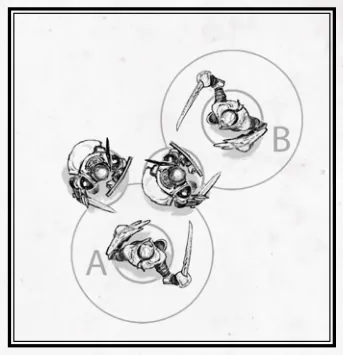
If Warrior A Targets the Enemy Warriors with a Clash Action, they will be Outnumbered from the assisting Warrior B, Rolling an Additional Attack for the Clash Action.
If Warrior B Targets the Men at Arms with a Clash Action, Warrior A cannot assist as they are Engaged with another Enemy.
Shooting Actions Take Aim - Out of combat action
This Warrior becomes Aimed! this Activation. Aimed!: This Warrior gains +1 to their Barrage Special Rule. A Warrior must have the Barrage X Special Rule to become Aimed!
Volley - Out of combat action
May only be performed if this Warrior has the Barrage X Special Rule. This Warrior Targets a single Enemy within this Warrior's Barrage Range and Line of Sight, checking for any Intervening Warriors or Obscuring Terrain (see below). This Warrior then follows the Attack Sequence (Page 26).
Obscured
When performing Volley Actions, if any part of the Line of Sight is impeded by Terrain of at least half the Size of the Target, then the Target Warrior Rolls an additional Block Die during that Volley Action.
Intervening
When determining the Target of Volley Actions, if any part of the Line of Sight is impeded by another visible Warrior (Friendly or Enemy) of at least equal Size of the Target, then they cannot be targeted with a Volley Action as the shot would be intervened by an Ally or a more pressing Enemy!
Size Matters
When performing Volley Actions, any Intervening Warriors or Obscuring Terrain may be ignored if they are both a smaller Size than this Warrior and are closer to this Warrior than to the Target.
Morale Actions Rally - Out of combat action
May only be performed while Broken! This Warrior Rallies. (Remove their Broken Marker)
Combat Rally - combat action
May only be performed while Broken! This Warrior Rallies (remove their Broken Marker), then must immediately take a single Resolve test. If Passed, they may continue their Activation as normal. If Failed, their Activation immediately ends.
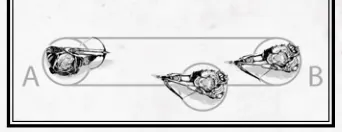
Both Warriors have LoS to each other, however the LoS is Intervened by another Warrior. Meaning that neither Warrior A or Warrior B can target each other with Volley Actions.
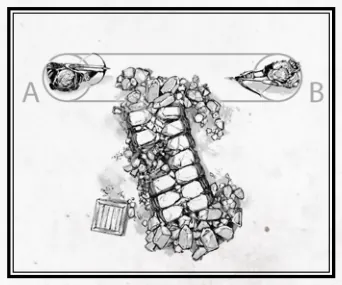
Both Warriors have LoS of each other but are Obscured by Terrain granting them each +1 Defense from Volley Actions.
Unique Actions
Through martial skill, preternatural ability, or overwhelming strength, certain Warriors are capable of performing powerful feats of carnage and bloodshed.
Any Action listed in a Warrior's Profile is referred to as an Unique Action. These Actions may specify whether they are (Combat Actions) or (Out-of- Combat Actions) and may only be performed when you can perform Actions of that type.
These Actions will specify their effects. Unique Actions listed as neither a (Combat Action) or (Out-of-Combat Action) can be performed while Engaged or Unengaged.
Some Warriors possess Unique Actions that serve as an alternate and more powerful version of a basic Action such as a (Unique Clash Action) or a (Unique Volley Action). These Unique Actions may be performed instead of the basic version of the Action. These Unique versions of Actions cannot be performed in the same Activation as the Basic version of that Action.
Unique Actions are treated as the Basic Action for the purposes of Special Rules. Unique Actions only use the Special Rules specified within the Action and NEVER benefit from Special Rules listed the Warrior's Profile or bonuses granted from Spells, Command Abilities, or Statuses.
Note that Unique Actions that simply inflict Hits ignore the usual Rules for performing their basic Counterparts such as Outnumbered Enemies, Intervening Warriors, or Obscuring Terrain!
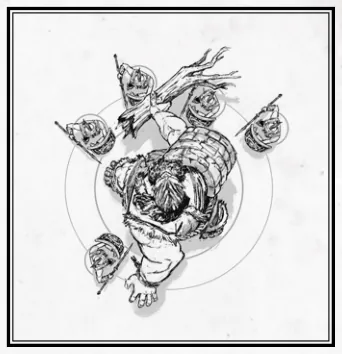
In the example above, the Monster performs the Sweeping Blow (Unique Clash Action); it cannot perform a basic Clash Action during the same Activation.
Enemy Warriors Hit by this attack may still benefit from Special Rules such as the Counter Attack Special Rule, as it is still considered a 'Clash' Action.
Out of Sequence Actions
Certain Special Rules will allow Warriors to perform Free Actions during their Activation or to perform Actions outside their Activation. Any Actions performed outside of a Warrior's 2 selected Actions during their Activation are referred to as Out of Sequence Actions. Out of Sequence Actions follow all the normal limitations of the Action, such as being Engaged for Combat Actions. An Out of Sequence Action performed during an Activation does not allow the Warrior to perform Duplicate Actions.
Example: A Warrior has a Unique Special Rule allowing for them to perform an immediate Volley Action after slaying an Enemy during a Clash Action. This does not allow that Warrior to also perform a second Volley Action during that same Activation.
Attacks, Hits and Blocks
Engaged in combat, Warriors unleash a flurry of blows and an onslaught of well placed strikes. A Warrior must best their opponent through superior skill or savagery; lest they fall victim to the bite of an axe or the tip of a spear.
Attacks vs Hits
Attacks is the total number of Dice Rolled as part of a Clash or Volley Action that may potentially be converted into Hits. This represents the ferocity or firepower generated by a Warrior.
Hits are the number of blows that strike a Warrior. Hits inflict Wounds unless Blocked. If any effect inflicts Hits upon a Warrior, Roll Dice equal to the Hits inflicted and that Warrior must then Roll Blocks to negate them. Hits are always Rolled by the Enemy Player.
Inflicting Hits
- If a Rule inflicts Hits on a Warrior, the Enemy Player Rolls the indicated number of Dice and assigns them as Hits.
- Results of '6' are always considered Failures and are always discarded.
- Set Hits to the side (keeping their results visible).
Rolling to Block and Negating Hits
- The Target then Blocks, Rolling Dice equal to either their Defense or Evasion Characteristics (chosen by the Defender). *The Defender may Roll more Block Dice than Hits they have suffered!*
- The Defending Player takes their Rolled Results and compares them to the Hits in their pool. The Blocking Warrior negates Hits by using a single Block Roll to negate a Hit of an equal result or higher.
- For each Hit not Blocked, the defender suffers a Wound.
Attacks and Hits against Multiple Warriors
- If multiple Warriors are Attacked or suffer Hits simultaneously, the order in which they are Resolved are chosen by the Activating Player.
- Fully Roll Attacks, Hits, and Blocks for a single Warrior before resolving the next.
The Attack Sequence
When performing both Clash Actions and Volley Actions, Attacking is resolved in the same way.
1. Attack
— Roll Dice equal to...
- this Warrior's Attacks (A) if a Clash Action.
- this Warrior's Barrage (X) if a Volley Action.
2. Assign Hits
— The Attacker then takes the Dice with the lowest results up to their…
- Clash (C) if a Clash Action.
- Volley (V) if a Volley Action.
- These Dice are Hits directed against the Enemy.
- Results of '6' are always failures and are discarded!
3. Block
— The Defender then attempts to Block Rolling Dice equal to either their Defense (D) or Evasion (E) Characteristic. Whichever is highest! The Defender then compares their results to the Attacking Warrior's Hits. Each Block Roll can negate a Hit that is the same number or higher.
4. Wounds
— For each Hit not Blocked, the Target suffers a Wound; mark the Warrior appropriately. If the defending Warrior accumulates Wound Markers equal to or greater than their Wounds Characteristic, the Warrior must immediately Test their Resolve (see Page 28).
Let's see an example of how the Attack Sequence is applied in Action!
Step 1 - Attacker Rolls
In this Example, the Attacker Rolls 4 Attacks as they have a total Attacks Characteristic of 4.
Step 2 - Assigning Hits
The Attacker must then allocate Hits from their Attacks equal to their Clash or Volley Characteristic.
The lowest Attacks must be chosen to be converted into Hits. Here, the Attacker assigns 2 Hits, as their Clash Characteristic is '2'. The Attack Rolls of '2' and '3' are allocated as Hits as they are the lowest results Rolled.
Step 3 - Rolling Defense
In this example, the Defender has a Defense Characteristic (or Evasion) of '3' and Rolls 3 Blocks.
Step 4 - Compare Defense Results to Hits
In this example, the Block Roll of '3' negates the Hit of '3'.
The Block Rolls of '4' and '6' fail to negate as they are not equal to or lower than any of the Hits. Note that all results of '6' when either Attacking or Blocking are always failures!
Step 5 - Defender Suffers Wounds and Tests Resolve
The Defender suffers a Wound for every Hit that was not Blocked. If the Defender accumulates Wound Markers equal to or greater than their Wounds Characteristic, the Warrior must immediately Test their Resolve (see Page 28).
Now let's see another example adding a certain Special Rules into the Sequence!
Step 1 - Attacker Rolls
The attacking Warrior Rolls 3 Dice as they have an Attacks Characteristic of 3. This is the Primary Roll.
Step 2 - Re-Rolls and Additional Attacks
Resolve any Re-Rolls and additional Attacks generated. All effects that trigger on a Dice result are resolved simultaneously. Here, the Attacker has the Special Rule, and the Defender has the Special Rule.
Both Special Rules occur simultaneously on an Attack Roll of "1" and would be resolved together. In this example the Attacker Rolled an additional Attack result of '3' and Re-Rolled the '1' into a result of a '4'.
Step 3 - Assigning Hits
The Attacker then allocates the lowest Attacks from their results up to their Clash Characteristic as Hits on the Enemy. The attacking Warrior assigns 2 total Hits, as their Clash Characteristic is '2'. The Attack Rolls of '2' and '3' are allocated as Hits as they are the lowest results Rolled.
Step 4 - Rolling Defense
In this example, the Defender has a Defense Characteristic of '3' and Rolls 3 Blocks.
Step 5 - Compare Defense Results to Hits
Compare the results of the Defense Roll to the Hits allocated by the Attacker. For each Defense result equal to or under a Hit is considered a Block and Blocks a single Hit of the same Value or greater. In this example, the Defense Roll of '3' negates the Hit result of '3'.
The Defense Rolls of '4' and '6' fail to Block as they are not equal to or lower than any of the Hits.
Step 6 - Defender Suffers Wounds and Tests Resolve
The Defender suffers a Wound for every Hit that was not Blocked. If the Defender accumulates Wound Markers equal to or greater than their Wounds Characteristic, the Warrior must immediately Test their Resolve.
Inflicting Wounds and Testing Resolve
A battlefield is a bloody and perilous place, and war is a cruel and unforgiving inevitability. When injured, Warriors will either succumb to their wounds, or fight on through rage or indomitable strength of will.
Inflicting Wounds
For each Hit that has not been Blocked, the Warrior suffers a Wound. Place a Wound Marker on the Warrior. A Warrior that has one or more Wound Markers on it is considered Wounded.
Testing Resolve
When a Warrior accumulates Wound Markers equal to their Wounds Characteristic, they must immediately perform a Resolve Test. Roll a Die, if the result is equal to or under the Warrior's Resolve Characteristic they survive and ignore the Wound but become Broken!
If this Test is Failed, the Warrior succumbs to their wounds and is Slain; remove the Warrior from the Battlefield.
Overkill
If a Warrior suffers Wounds in excess of their Wounds Characteristic, they suffer -1 Resolve for each excess Wound suffered for the ensuing Resolve Test. A Warrior's Resolve to be reduced to '0', causing the Resolve Test to be impossible to succeed!
If a Warrior passes the Resolve Test, remove Wound Markers until the Warrior has only a single Wound remaining then the Warrior becomes Broken!
Example: A Men-at-Arms suffers 2 Wounds after Rolling to Block. The Men-at-Arms must now Test Resolve, Rolling a single Die and the result must be equal to or under the Men-at-Arms modified Resolve of '1' (base Resolve of 2 -1 from Overkill) to survive.
Slain and Destroyed
The terms Slain and Destroyed are used interchangeably but both cause a Warrior to be taken out of the Battle. When a Warrior is Slain or Destroyed they are removed from the Battlefield.
Broken Warriors and Resolve
A Broken! Warrior automatically fails all Resolve Tests and will be Slain if they accumulate Wound Markers equal to or beyond their Wounds Characteristic.
Driven Back
If a Warrior within Engagement causes an Enemy to be Broken!, they are immediately Driven Back.
When a Warrior is Driven Back either by becoming Broken! from an Enemy within their Engagement Range or from a Special Rule; The Broken! Warrior is Moved directly away from the Enemy that caused them to be Driven Back until there are 2" between them or they contact another Warrior or Impassable Terrain.
Healing and Raising
Through unnatural vigor, alchemical process, or divine intervention, certain Warriors have the ability to restore their broken forms or even return from death.
Healing
When a Warrior is Healed, remove Wound Markers from the Warrior equal to the amount they were Healed.
Raising Warriors
Certain Abilities and Special Rules can allow Slain Warriors to return to the Battlefield. The Special Rule or Ability that Raised the Warrior will specify where to Place the Raised Warrior. A Warrior that is Raised may be Activated normally this Round.
Last updated