Terrain
In this chapter9
In this section we will introduce how forces interact with their environment either by taking cover in dense forests or garrisoning vantage points.
From the crumbling ruins of the Old Dominion to the verdant domains of the Weaver Courts, the lands of Eä are accustomed to war. Battlefields are composed of various elements that may prove either favorable or fatal to fight within. From trudging through muck and mire, to scaling fortress walls, or taking cover behind a toppled tower, Warriors must use the terrain around them to their advantage.
As Terrain can vary vastly across any Player's collection, it is important that you and your opponent agree on what each Terrain feature on the Battlefield represents and the properties it has before the Battle.
Although this Chapter provides many suggestions for Terrain Properties to represent common Terrain features, players should feel free to use these rules to represent their Terrain for the most fair and immersive experience.
This is even more important for Vantage Points (see Page 45) and other three-dimensional features. A Vantage Point that also features a ruined wall on its platform can be simply represented by a Barricade atop of a Vantage Point. Vantage Points may even be granted other Terrain Traits if players see fit to do so.
Zonal Terrain
Zonal Terrain features are represented with flat zones that are size 0 and affect all Warriors within it. A Warrior with any part of their Base within the Zonal Terrain is considered to be within it.
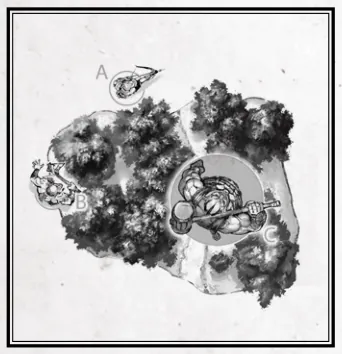
Warrior B and Warrior C are considered within the Forest, while Stalker A is not.
Terrain Traits
Hindering
Warriors that Move through Hindering Terrain never count as Charging.
Broken Ground
Warriors that Move through Broken Ground suffer -1 to their March Characteristic.
Water
Warriors suffer -1 Resolve while in Water.
Impassable
Warriors cannot Move through or Placed onto Impassable Terrain.
Obscuring
LoS Drawn from a Warrior currently not within this Terrain feature passing through this Terrain is always counted as Obscured.
Elevation X
This Terrain has a Size of X. All Warriors and other Terrain features within this Elevation add +X to their Size when determining Line of Sight.
Example: A Size 3 Warrior is on top of a size 1 Hill. This Warrior is now considered Size 4 for determining Line of Sight.
Dangerous
A Warrior that Moves through or comes into contact with Dangerous Terrain immediately suffers a single Hit.
Common Terrain Types
The following list is an example of Traits utilized for Common Zonal Terrain Features.
- Chasm — Impassable and Dangerous
- Forest — Hindering and Obscuring
- Marsh — Broken Ground and Hindering
- Molten Fissure — Broken Ground and Dangerous
- Pond — Hindering and Water
- Ruins — Broken Ground and Obscuring
- Hill — Elevation 1
Barricades
Many Battlefields are littered with rubble, short walls, and fences (shorter than 2" in Height and less than 1" in depth) which can be used by Warriors to take a defensible position.
Barricades are Size 1. Warriors may ignore Barricades when Moving during their Activation but may not end a Move on top. Warriors that Move over or are Engaged with Enemies across a Barricade never count as Charging.
If a Brute or Monster Moves over a Barricade during their Activation, it is immediately Destroyed; remove the Barricade from the Battlefield. Warriors in contact with a Barricade may perform the Dismantle Action.
Dismantle - Out of Combat Action
This Action may only be performed if this Warrior is in contact with a Barricade. Destroy a Barricade in contact and remove it from the Battlefield.
Size and Terrain
All non-Zonal Terrain have a corresponding Size, used for determining if Line of Sight is Obscured or blocked completely. To determine the Size of a terrain feature, refer to the chart below.
| Height | Size |
|---|---|
| ≥2" | 2 |
| ≥3" | 3 |
| ≥4" | 4 |
| ≥5" | 5 |
| ≥6" | 6 |
Vantage Points
Representing the walkable tops of castle walls, rocky plateaus, or the ramshackle scaffolding of a crumbling hamlet; any elevated position where warriors may move and fight upon.
Vantage Points are Terrain features that have level surfaces fit for Moving Warriors across. A Vantage Point has the Elevation X Trait, where X is Equal to the Vantage Point's Size.
A Vantage point cannot be Moved onto, a Warrior must be Placed upon it. A Warrior may only Move across or be Placed onto a Vantage Point if its base wholly rests on the Terrain feature.
Warriors in contact with a Vantage Point may perform the Climb Action. Cavalry and Monsters cannot be Placed upon a Vantage Point.
Climb - Out of Combat Action
This Action may only be performed if this Warrior is in contact with a Vantage Point that is equal Size to this Warrior or smaller. Place this Warrior onto or off of the Vantage Point wholly within 3".
This Action cannot be performed if there is not enough room for the Warrior to be Placed. Cavalry and Monsters cannot perform the Climb Action.
Pathways
A Pathway is a term for ladders, stairs, doorways, tunnels, or any other method of accessing different parts of Vantage Points.
An Unengaged Warrior may travel through a Pathway by ending their Movement in contact with a Pathway. Place this Warrior in contact with the other side of the Pathway.
A single Pathway may have multiple entrances/ exits. Cavalry and Monsters cannot travel through a Pathway. A Warrior that cannot travel through a Pathway due to Enemies may instead perform the Breach Action.
Breach - Out of Combat Action
This Action may only be performed if this Warrior is in contact with a Pathway that they cannot travel through due to Enemies.
This Warrior performs a Clash Action Targeting any Enemies within 3" of the other side of the Pathway. Cavalry and Monsters cannot perform the Breach Action.
Overhangs
Vantage Points may be suspended from the ground or have open doorways, with enough space for Warriors to Move through.
These Areas underneath Vantage Points are referred to as Overhangs. Warriors may draw Line of Sight under Overhangs freely.
If a Warrior is at least partially underneath an Overhang, it cannot draw Line of Sight to Warriors on top of that Vantage Point or vice versa.
A Warrior may move under Overhangs granted there is enough clearance for them to fit! A Warrior may only Move under Overhangs that are of an equal or Greater Size than the Warrior themselves.
Example: An Ugr (Size 3) may only move under an Overhang that is Size 3 or greater.
Windows and Openings
Whether a Window, Arrowslit, or gap from a crumbling Wall. Openings serve as strategic locations to strike the Enemy from afar with powerful Volleys.
Line of Sight may be drawn through Windows and Openings to and from Warriors with 1" of the Opening. Only Warriors within 1" of the Opening can be Obscured from this Terrain.
Vantage Points & Engagement
A Warrior may Engage Enemies upon a Vantage Point if the Warrior's total Size is greater than that of the Vantage Point the Enemy is upon.
Precarious Terrain
Vantage Points such as walkways or the edge of a rooftop pose a significant threat to those caught fighting upon them; be it by a fateful misstep or by the brute force of a foe.
When a Warrior is Driven Back into contact with the edge of a Vantage Point, the Warrior loses their footing and falls. Place the Warrior at the bottom of the Vantage Point as near as possible to where they had fallen from.
The Warrior then immediately suffers Hits equal to the total difference of Elevation from where they fell from to where they were Placed. The Battlefield is treated as Elevation 0.
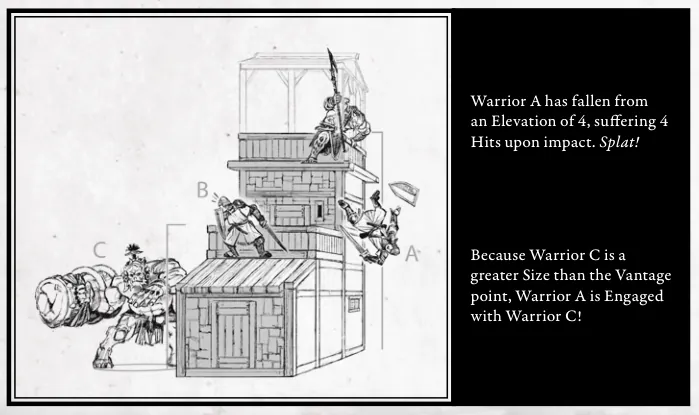
Warrior A has fallen from an Elevation of 4, suffering 4 Hits upon impact. Splat!
Because Warrior C is a greater Size than the Vantage point, Warrior A is Engaged with Warrior C!
Last updated