Terrain
Chapter 10
On this page2
In this section we will introduce how forces interact with their environment either by taking cover in dense forests or garrisoning vantage points.
Conquest Battlefields consist of two kinds of Terrain, each offering different tactical advantages and challenges: Zonal Terrain and Garrison Terrain. Zonal Terrain represents an area on the Battlefield that confers specific advantages or penalties but can otherwise be moved through without additional rules.
Examples of Zonal Terrain include hills, swamps, rivers, and broken ground. Garrison Terrain pieces represent areas of dense Terrain, unsuitable for a Regiment to move through in formation, but offer substantial bonuses to warriors who seek to occupy them.
Elevation Rules
Areas of elevated Terrain, such as hills, allow your Regiments to see over other Regiments and Cover Terrain. The Battlefield is considered to be Size 0 unless otherwise stated.
Some Zonal and Garrison Terrain features, such as hills and castle walls, have the Elevated keyword. A Regiment on top of a piece of Zonal Terrain with the Elevated keyword treats its Size as the sum of their Size and the Terrain piece's Size.
Example: A Regiment of Militia Bowmen (Size 1) sits on top of a hill (Elevated, Size 2), therefore treating their Size as if they were a Size 3 Regiment.
Stands can trace Clear Shots over other Regiments and Obstructing Terrain with a lower Size. So, Stands that are Elevated and Size 3 can see over Stands at Elevated, Size 2. Similarly Stands that are Elevated, Size 4 can see over Stands that are Elevated, Size 3 and/or Size 2 and so on.
Similarly, a Stand directing a Volley at a Target with a higher Size ignores all Regiments and Obstructing Terrain with a lower Size value than the Target.
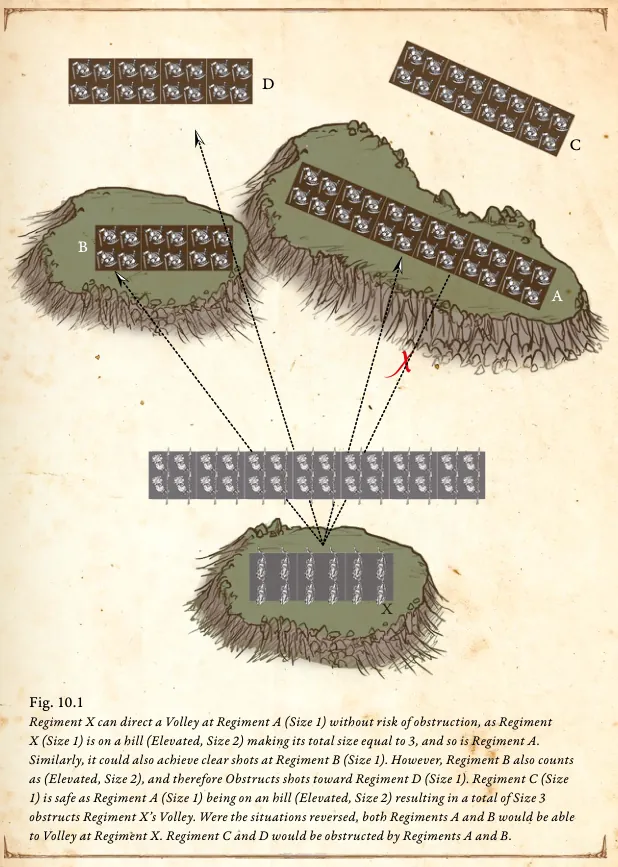
Regiment X can direct a Volley at Regiment A (Size 1) without risk of obstruction, as Regiment X (Size 1) is on a hill (Elevated, Size 2) making its total size equal to 3, and so is Regiment A. Similarly, it could also achieve clear shots at Regiment B (Size 1). However, Regiment B also counts as (Elevated, Size 2), and therefore Obstructs shots toward Regiment D (Size 1). Regiment C (Size 1) is safe as Regiment A (Size 1) being on an hill (Elevated, Size 2) resulting in a total of Size 3 obstructs Regiment X's Volley. Were the situations reversed, both Regiments A and B would be able to Volley at Regiment X. Regiment C and D would be obstructed by Regiments A and B.
Zonal Terrain
Regiments can March into and through Zonal Terrain. However, different types of Zonal Terrain confer advantages and penalties, depending on the Special Rules assigned at the start of the battle.
Zonal Terrain can be of any size and shape. As Zonal Terrain is often modeled into the game board, it's important for you and your opponent to agree on the types and extents of each area of Zonal Terrain before the first Reinforcement Phase, just so there are no surprises. When a Stand has any part of it within those extents, then it is considered to be within this piece of Zonal Terrain.
Rather than dictate the rules for particular areas of Zonal Terrain, we are instead providing a list of Zonal Terrain rules that can be applied to areas of your Battlefield. In theory, you can use as many of these as you wish for each area of Zonal Terrain, but we would recommend sticking with maybe two or three.
You'll also need to agree on which pieces of Zonal Terrain are also Cover or Obstructing Terrain. Normally this will be hills and forests, but ruins, cornfields and other features might also require some thought.
It is up to Players or Organizer to determine Zonal Terrains on the Battlefield. Every Zonal Terrain has an associated Size (a minimum of 0 and up to a maximum of 4) and can have multiple keywords with the following rules:
Examples:
• Forest: Size 3, Traversable, Hindering, Cover
• Hill: Size 2, Obstructing, Elevated
Elevated
Regiments can move through Elevated Terrain. Stands on top of Zonal Terrain with the Elevated keyword treat their Size as the total of their Size and the Terrain piece's Size.
Cover
Stands drawing Line of Sight through this piece of Zonal Terrain as part of a Volley Action and/or Targeting a Regiment with all of its Stands within Cover Zonal Terrain, halve the X value in their (X) Special Rule (Rounding up). A Regiment only benefits from the Cover Special Rule if its Size is equal to or less than the Size of the Zonal Piece of Terrain.
Should a Regiment have all of its Stands within the same piece of Zonal Terrain the Target Regiment is in, then its Stands suffer no penalty to their (X) Special Rule as a result of drawing Line of Sight through. If a Stand within this piece of Zonal Terrain is drawing Line of Sight through another piece of Cover Zonal Terrain it suffers the penalty to its (X) Special Rule as normal.
Obstructing
Zonal Terrain with this keyword does not allow Line of Sight from Regiments of an equal or smaller size to be drawn through it. Stands that are on a piece of Obstructing Zonal Terrain can freely draw Line of Sight to Enemy Regiments and vice versa regardless of Size.
Traversable
Regiments can move through Traversable Terrain. This piece of Zonal Terrain does not add its Size to the total Size of a Regiment.
Hindering
When at least half of a Regiment's Stands (Rounding up) Charge through a piece of Zonal Terrain with this keyword, the Regiment does not inflict any Attacks during that Charge Action. In addition, Medium and Heavy Regiments do not benefit from the Special Rule during a Round in which at least half of their Stands (Rounding up) Charged through this piece of Zonal Terrain.
Dangerous
When a Regiment moves onto, or through a piece of Zonal Terrain with this keyword, Roll a die for each Stand that moves through this terrain. For each Roll of "6", the Regiment suffers 1 Wound. Cavalry and Chariot Stands will suffer 2 Wounds for each Roll of "6" instead. You do not need to Test Morale against Wounds caused by Dangerous.
Perilous
When a Regiment moves onto, or through a piece of Zonal Terrain with this keyword, Roll a die for each Stand that moves through this terrain. For each Roll of "4, 5, 6", the Regiment suffers 1 Wound. Cavalry and Chariot Stands will suffer 2 Wounds for each Roll of "4, 5, 6" instead. You do not need to Test Morale against Wounds caused by Perilous.
Impassable
Regiments cannot move through Impassable Terrain.
Water
If a Regiment has at least half its total Stands (Rounding up) within this piece of Zonal Terrain, it suffers a -1 penalty to its Clash Characteristic, to a minimum of 1.
Garrison Terrain
The rules for Garrison Terrain are used to represent features such as buildings and fortified positions. As with Zonal Terrain, it is important to agree to the boundaries of any Garrison Terrain features before the first Reinforcement Phase, as well as other properties, like Elevated. In terms of the size of Garrison Terrain features, the rules presented here assume you are using pieces of Garrison Terrain roughly 4˝ to 6˝ in diameter. If you are using larger or smaller Garrison Terrain features, you may want to adapt the rules to match your collection. Just remember to discuss any changes with your opponent before the battle begins!
We recommend Garrison Terrain features be placed at least 6˝ apart and 6˝ from the edges of the Battlefield as well as not overlapping with any Objective Zones.
A Regiment cannot March into or through Garrison Terrain. In fact, it cannot March to within 1˝ of Garrison Terrain unless it is seeking to Occupy that Garrison Terrain.
Occupying Garrison Terrain
Each Garrison Terrain feature has a Defense (X) value and a Capacity (X) value as well as Elevation.
Only Infantry Regiments can Occupy Garrison Terrain and, even then, only if the number of Stands is equal to or less than the Capacity (X) value of the Garrison Terrain. For all game purposes, due to the close confines of Garrison Terrain, the Occupying Regiment will always be considered to have a front Rank composed of all of its remaining Stands. Most pieces of Garrison Terrain are considered to have Capacity (4). However, you may feel free to adjust this to fit the pieces of terrain in your collection.
Your Regiment Occupies an Unoccupied Garrison Terrain feature by Marching into contact with it. Remove the Regiment from the table, and place any number of Stands or Models anywhere on the Garrison Terrain, to show who Occupies it. If the Regiment has any remaining Actions, they are lost and their Activation ends.
If there are too many Stands to fit inside the Garrison Terrain, your Regiment cannot Occupy it, and must halt its March 1˝ away.
While in Garrison Terrain, all Stands in the Occupying Regiment have +X Defense, where X is the Defense value of the Garrison Terrain and consider their Size the same as the Garrison Terrain' Size. Most pieces of Garrison Terrain are considered to have Defense (1).
However, you may feel free to adjust this to fit the pieces of terrain in your collection. A Regiment within Garrison Terrain has a full 360° Line of Sight.
Leaving Garrison Terrain
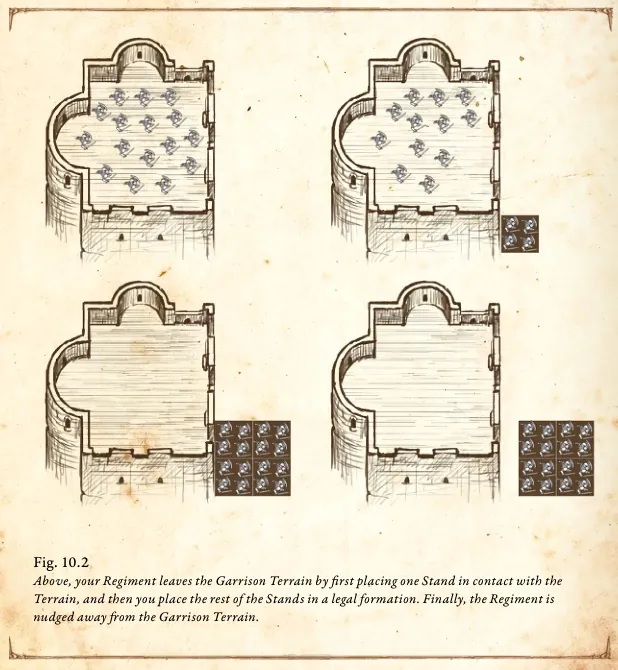
Your Regiment can leave the Garrison Terrain it is Occupying by performing two March Actions. Return all Models and Stands to the Regiment and place one Stand anywhere in contact with any edge of the Garrison Terrain. Then, place all other Stands from your Regiment in a legal formation, with no Stand further from the Garrison Terrain than its lowest March Characteristic, at least 1˝ away from all Enemy Regiments and not overlapping other Friendly Regiments or pieces of Garrison Terrain. If you cannot place all other Stands within the Regiment's March Characteristic, then you may place them up to double the Regiment's lowest March
Characteristic, but the Regiment is now Broken.
If the Regiment cannot be placed within double its lowest March Characteristic, then the Regiment cannot leave the piece of Garrison Terrain it is Occupying at all.
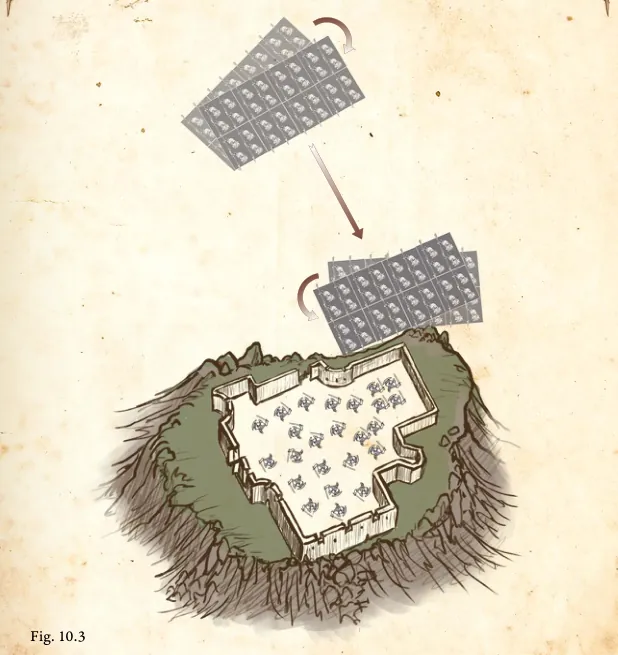
Once the Regiment has successfully left the piece of Garrison Terrain, it is pushed 1˝ away from the piece of Garrison Terrain and its Activation ends. If it cannot be pushed 1˝ away because that would either bring the Regiment within 1˝ of an Enemy Regiment or cause it to overlap with other Regiments or pieces of Garrison Terrain, then push it as much as possible.
This is the only exception allowing a Regiment to be within 1˝ of a piece of Garrison Terrain it is not Occupying or Engaging.
A Regiment cannot Occupy and leave a piece of Garrison Terrain in the same Round.
Above, your Regiment leaves the Garrison Terrain by first placing one Stand in contact with the Terrain, and then you place the rest of the Stands in a legal formation. Finally, the Regiment is nudged away from the Garrison Terrain.
Withdraw From Garrison Terrain
A Regiment Occupying a piece of Garrison Terrain may choose to leave it even if in Contact with an Enemy Regiment. Follow the rules as explained above.
Charging Garrison Terrain
Your Regiment may take a Charge Action against a piece of Garrison Terrain Occupied by an Enemy Regiment as if it were an Enemy Regiment itself.
As Garrison Terrain features are seldom rectangular in shape, Wheeling flush will not always be possible. Instead, Wheel your Regiment as close to Flush as you can by the shortest possible distance.
Garrison Terrain and Impact Attacks
Regiments do not benefit from the (X) Special Rule when Charging a piece of Garrison Terrain.
Clash Actions and Garrison Terrain
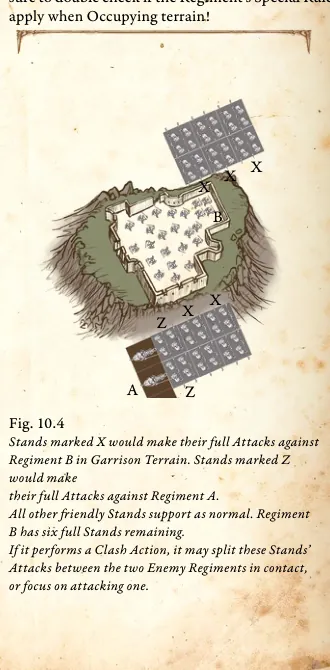
If your Regiment is in contact with a piece of Garrison Terrain Occupied by an Enemy Regiment, it may take a Clash Action against that Occupying Enemy Regiment. In order to accommodate irregular Terrain features, all Stands in a Regiment's first Rank calculate their Attacks as if they were in contact with the Occupying Enemy Regiment while all other Stands contribute Supporting Attacks as normal.
The only exceptions are Stands in contact with other Enemy Regiments – these Attacks must Target one of the other Regiments in contact, even if they are also in contact with the Garrison Terrain.
The Clash Action is otherwise resolved as normal.
If your Regiment is Occupying a piece of Garrison Terrain and an Enemy Regiment is Engaging it, it may take a Clash Action against it. If it does so, all Stands in your Regiment Attack as if they were in contact with the Enemy Regiment.
If there is more than one Enemy Regiment in contact with the Garrison Terrain, you may have each Stand Target different Enemy Regiments in contact with it– even foregoing Attacks against one Enemy Regiment in favor of focusing on another. The Clash Action is otherwise resolved as normal.
Wiped Out in Garrison Terrain
If a Regiment in Garrison Terrain is destroyed by any means, one Enemy Regiment that is in contact with the Garrison Terrain and is capable of Occupying the Garrison Terrain feature may immediately do so. This does not cost the Regiment any additional Actions; however, its Activation still ends.
Any Enemy Regiments in contact with the Garrison Terrain that cannot do so can immediately perform a free additional Reform Action instead.
Volley Actions and Garrison Terrain
A Regiment Occupying Garrison Terrain can make Volley Actions as normal. The Regiment may perform a Volley Action in any direction, measuring Range and calculating Line of Sight from any edge of the Garrison Terrain.
Calculate the Size of the Volleying Regiment as equal to the Elevation (X) rule of the Garrison Terrain feature for the purpose of drawing Line of Sight. Stands in the Regiment perform a Volley as normal.
As some Special Rules, like , do not work when Occupying a piece of Garrison Terrain, make sure to double check if the Regiment's Special Rules apply when Occupying terrain!
Stands marked X would make their full Attacks against Regiment B in Garrison Terrain. Stands marked Z would make their full Attacks against Regiment A. All other friendly Stands support as normal. Regiment B has six full Stands remaining. If it performs a Clash Action, it may split these Stands' Attacks between the two Enemy Regiments in contact, or focus on attacking one.
Last updated